

Chapter Two: Diaspora (תְּפוּצָה)
Now therefore, behold, the Lord brings up over them the waters of the River, strong and mighty – The King of Assyria and all his glory; He will go up over all his channels And go over all his banks. He will pass through Judah, He will overflow and pass over, He will reach up to the neck: and the stretching out of his wings Will fill the breath of Your land, O Immanuel.
Isaiah 8:7, 8:8
The Struggle for the Levant
Judah and Israel would continue to rule their regions until mid-700 BCE when they were caught up in Assyrian expansion. The region was attacked by Shalmaneser II, then by Tiglath-Pileser III, then the Shalmaneser V. Finally, Sargon II with his son Sennacherib completed the work. From 734 BCE to 715 BCE, all Israelites were removed from the land to make room for other members of the Assyrian Empire.
In 705 Sennacherib, son of Sargon II looked to finish the job and invaded Judah, besieging Jerusalem. The outcome is disputed, Sennacherib claims he sacked Jerusalem; however, the Bible says that failed when an angel struck down his troops. Either way, Sennacherib had to abandon the siege though he exacted a huge price.
This marks one of many forced removals of the Israeli people from the region.[i] The Mishnah says that the Kingdom of Judah was allowed to return but the 10 northern tribes never did, today they are referred to as the lost tribes of Israel. What is notable is that not only did the people return, demonstrating the importance of the area, but those who newly entered the region embraced the existing culture, with many accepting Judaism.

One hundred years later, in 605 BCE, Nebuchadnezzar II became the leader of the Chaldean dynasty of Babylonia. He immediately took his armies west. In 597 BCE he attacked Judah, capturing Jerusalem. His scribe describes the events:
The seventh year, in the month of Kislev, the king of Akkad mustered his troops, marched on Hatti, and set up his quarters facing the city of Yehud [Judah] in the month of Adar, the second day, lie took the city and captured the king. He installed there a king of his choice. He collected its massive tribute and went back to Babylon.
The city and the first temple of Jerusalem were destroyed. In addition, it is believed that a sizable population was forcibly removed to Babylon and Egypt. [ii] It is possible that our ~100th great-grandparents were among them.
60 years later, Cyrus the Great conquered Babylon and establishing the Persian Empire as the primary power in the known world. Cyrus is known to have been a tolerant ruler. In his first year he issued a proclamation which allowed the Jewish People to return to Israel and rebuild their temple:
Thus said King Cyrus of Persia: The LORD God of Heaven has given me all kingdoms of the earth and has charged me with building Him a house in Jerusalem, which is in Judah. Anyone of you of all His people – may his God be with him, and let him go up to Jerusalem that is in Judah and build the House of the LORD God of Israel, the God that is in Jerusalem. [iii]
Further tests of the Jewish faith began in the mid-400s BCE when the Persian king, Artaxerxes, attempted to enforce the worship of the Persian goddess Anahita. For the Jewish people this was forbidden as the bible says, “You shall not make idols for yourselves” … “for I am the LORD your God.”[iv] It is possible that this struggle was narrated in the book of Esther, though there is debate if this occured at the same time. The Bible tells us that Mordecai, from the tribe of Benjamin, thwarted Haman’s plans to destroy the Jews, thanks to his cousin Esther. Esther is believed to have been the wife of Artaxerxes. Mordecai discovered Haman’s plot and asked Esther for help. Esther tells the king “We have been sold, my people and I”. The king asks, “who would dare presume in his heart to do such a thing?” When Esther answers, Haman is executed, and the Jews are saved. Mordecai ordered “the fourteenth day of the month of Adar with gladness and feasting as a holiday, and for sending presents to one another. He named it Purim.[v] [vi]
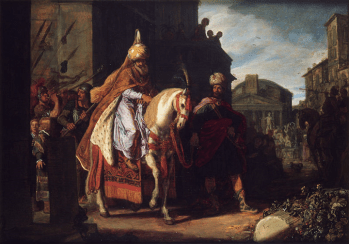
Things remained settled until 331 BCE when the young general, Alexander the Great conquered all Persian territories. Alexander became the master of Asia Minor and the Pharaoh of Egypt. After his death in 323 BCE Seleucus and Ptolemy split the empire between them. Judea stood on the border and would be nexus in the struggle between these two empires.
At first, Judea was safely within the Ptolemaic empire, which gave the Jewish people full civil rights. However, in 175 BCE, Antiochus IV Epiphanes became the King of the northern Seleucid Empire. One of his first acts was to invade the southern empire under Ptolemy. After the invasion, Antiochus who styled himself a demi-god, sought to impose Greek religious traditions onto the Jewish people, including worshipping Zeus. Judah Maccabee and his brother revolted to liberate Judea. After the Jews prevailed, they returned to the temple, shattered the statue of Zeus. They only found one small flask of uncontaminated oil, enough for one day. Legend tells us that, though it took eight days to produce a new batch of pure oil, the lamp remained lit for 8 days, until the new oil was ready. This is why we celebrate Hanukkah for eight days.[vii] . The Jewish people were once more left in peace, and again, strove to rebuild and move forward.
The Romans
In 67 BCE, the death of Judea’s Queen Regent, Alexandra Salome marked the end of independent rule. It all started when her younger son Aristobulus rejected his elder brother, Hyrcanus’s right to rule. They appealed to the Roman general, Pompey. Already involved in a war in Syria, Pompey did not welcome this dispute. Of this, the Jewish historian, Flavius Josephus writes:[viii]
Now the occasions of this misery which came upon Jerusalem were Hyrcanus and Aristobulus, by raising a sedition one against the other; for now we lost our liberty, and became subject to the Romans.[ix]
The assault on Jerusalem lased for 3 months and over 12,000 Jews were killed. After taking control of the area Pompey put neither Hyrcanus nor Aristobulus in charge. Instead, he divided the land and put it under Roman control. In 37 BCE, Herod the Great was installed as a puppet king. This appointment was not popular because he was not truly Jewish.[x] It resulted in a period of violence by the Jewish population who, as a result, faced severe retaliation from the Roman Empire. It is into this environment that Yeshua or Jesus was born.
It is believed that in 24 CE, Jesus began his ministry and gained many followers who also expected him to remove Rome from their lands. This caused conflict both with Rome and within the Jewish community. It resulted in Pontius Pilate ordering Jesus’s crucifixion. This act became the basis for Jewish persecution for nearly 2000 years.[xi]
In 66 CE, tensions between the Jews and Rome came to a boil when a group known as the Sicarii massacred a troop of Romans at Masada. In the same year, in Jerusalem, a rebel force attacked and killed 6,000 Roman soldiers.
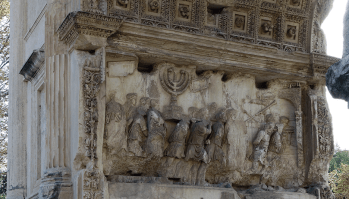
Rome’s response was brutal. With his son Titus, Vespasian brought 60k troops and swept through the area forcing Jews to retreat south to Jerusalem. A bloody prolonged siege of Jerusalem followed. Titus, seeking to break the will of the besieged population, crucified anyone that tried to escape. Despite this the Jews held out for a year. However, in 70 CE the siege succeeded. Titus looted and then destroyed the Temple. As seen on Titus’s triumphal arch, see figure 10, he forced the conquered Jews into slavery and made them carry the spoils from the temple back to Rome. To this day it has not been rebuilt and all that remains is the Wailing Wall surrounding the Temple Mount.
Having destroyed the Jewish Temple in Jerusalem, the Romans turned their attention to the Sicarii. Governor, Flavious Silva sent his army to Masada and besieged their fortress. To break the siege, the Roman army built a ramp of mud and stone. However, before the Romans could enter the fortress, all committed suicide, there may have been as many as 900 of them.[xii]
The destruction of the temple in Jerusalem and the near complete deterioration of Jewish tolerance in the Roman Empire, led to a major Diaspora. There is no way to know if our ~80th great-grandmother left the area at this time. If she did, she experienced a world that was growing more and more antisemitic. Claims of Blood Libels and Jews murdering Christians were gaining traction.[xiii] For those that stayed things continued to get worse. In 130 CE, Hadrian announced that he would establish a temple to Jupiter on the site of the ruins of the Jewish Temple in Jerusalem. This brought a bloody response. It was reported that many Jews and Romans died and the whole of Judea became a desert. As a result, Hadrian burned the sacred scrolls, erected statues of Jupiter, and forbid Jewish people from entering Jerusalem. To make it clear that this was a Roman territory, the area was renamed Syria Palestina.[xiv] In 138 CE, Hadrian died, and Antonius Pius overturned many of Hadrian’s laws. This brought sustained peace to the Jews in the area. However, by this time, Jewish presence in the area was greatly diminished, and would remain so for nearly 2,000 years.[xv]
[i] “The Founding of Israel, The journey to a Jewish Homeland from Abraham to the Holocaust” by Martin Connolly, pgs. 7
[ii] Tablet found in Iraq – “The Founding of Israel, The journey to a Jewish Homeland from Abraham to the Holocaust” by Martin Connolly, pgs. 15
[iii] Book of Ezra, Chapter 1
[iv] Leviticus 26:1
[v] “The Founding of Israel, The journey to a Jewish Homeland from Abraham to the Holocaust” by Martin Connolly, pgs. 17, 18
[vi] Book of Esther
[vii] “The Founding of Israel, The journey to a Jewish Homeland from Abraham to the Holocaust” by Martin Connolly, pgs. 19, 20
[viii] “The Founding of Israel, The journey to a Jewish Homeland from Abraham to the Holocaust” by Martin Connolly, pgs. 21, 22
[ix] IBID
[x] IBID
[xi] IBID, pg 24
[xii] IBID, pg 27
[xiii] IBID
[xiv] IBID, Pgs. 29-31
[xv] IBID, pg. 32
 Becoming Us