

Introduction:
“The Egyptian, the Babylonian, and the Persian rose, filled the planet with sound and splendor, then faded to dream-stuff and passed away; the Greek and the Roman followed; and made a vast noise, and they are gone; other people have sprung up and held their torch high for a time, but it burned out, and they sit in twilight now, or have vanished. The Jew saw them all, beat them all, and is now what he always was, exhibiting no decadence, no infirmities of age, no weakening of his parts, no slowing of his energies, no dulling of his alert and aggressive mind. All things are mortal but the Jew; all other forces pass, but he remains. What is the secret of his immortality?”
-Mark Twain, 1899
“Our survey of three and a half millennia of Jewish history is closed. But the story which we have set ourselves to tell is unending. Today, the Jewish people has in it still those elements of strength and endurance which enabled it to surmount all the crises of its past, surviving thus the most powerful empires of antiquity.”
-Cecil Roth, A History of the Jews
Over the next few chapters I will seek to tell the story of our families in the early 20th century. With over 17 different families’ stories to tell, it was a challenge to decide how to package this for you. Some readers will be interested in all of them. However, I suspect that many of you are here to learn about your specific ancestor. Therefore, I have decided to organize Part IV by family units. I will start with my great-grandparents Yosef Olej and Mindel Levin and will close part IV with my other great-grandparents, Kalman Besser and Freyda Popaver. In between you will find the families of Aharon Mayer Olej, Machel Olej, Rifka Olej, Isaac Olej, Chana Dworja Olej/Saltz, Berish Olej, Mordka Wolf Olej, Zisa Rajzla Levin; Lajb Levin, Frajda Levin, Benyaman Levin, Shlomo Mendel Levin, Jacob Levin, the sons and daughters of Avram Zamvel Besser, and the sons and daughters of Shlomo Popaver.
Chapter Eight: Yosef Olej and Mindel Levin in Pabianice

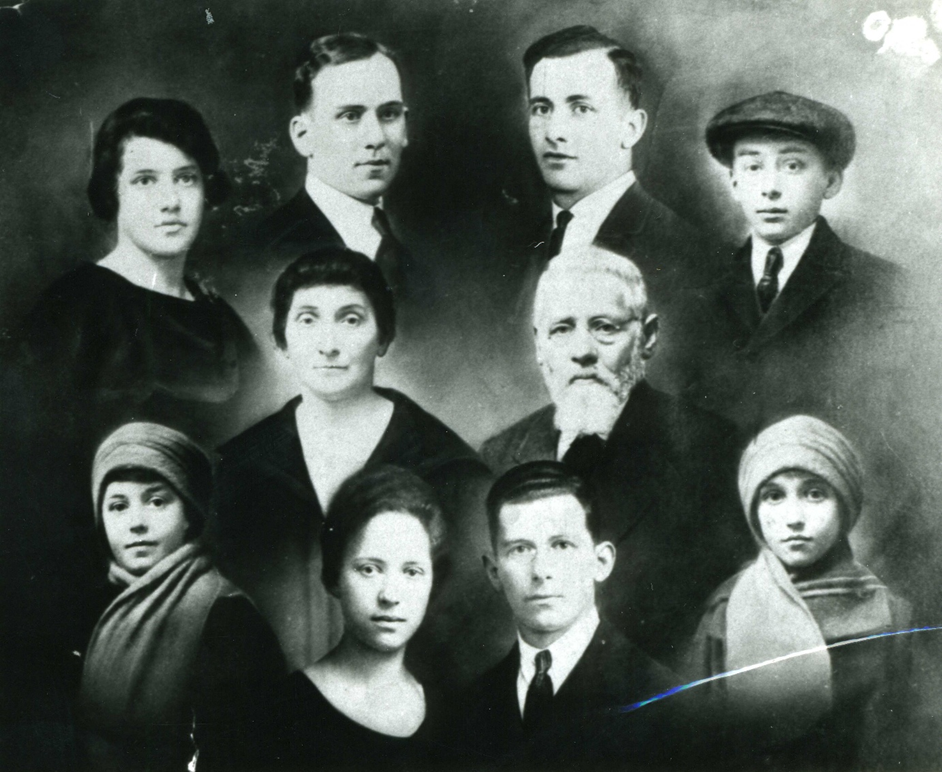
Their Children, from L-R: Machel Olej & Chaia Judowicz; Abraham Olej & Litcha Olej; Beresh “Benjamin”Olej & Sara Horowitz; Masha Olej, Yankle Olej, Jacob Ika & Bella Olej; Ayre “Leon” Olej & Cypora Besser; Sarah Olej & Mordichi Eber; Abush Adler & Ester Olej.
Yosef (Josek Lajzer) Olej and Mindel Levin (Mindla Lewin)[1] were married in Pabianice on the 23rd of January 1890. Yosef was 34 and Mindel was 19.[i]
Yosef was a Felczer, which is a position that no longer exists. Today it would be similar to a job that was a cross between a surgical assistant and a nurse practitioner. He gained his medical skills while serving in the Russian army. He joined or was conscripted around 1877, and his position was listed as a “spare senior barber-surgeon of the Department of the Mikhailovsky Fortress Artillery.”[ii] His service was during the Russo-Turkish War, though it is not known if he was involved. Given his assignment to the Mikailovsky Fortress Artillery, he may have been in St. Petersburgh’s Mikhailovski Artillery Academy aiding behind the lines.[2] Either way, when he returned, he began his career as a Felcezr, and Barber.[iii]
Mindel was Moshe Yosef and Masza Levin’s eldest of seven children. She sadly lost her mother in 1886, when Mindel was only fourteen.[iv] Within two years her father, married Sura Ruchla Baum. Unfortunately, Mindel did not get along well with Sura, which could be part of the reason for such an early marriage and her desire to be a loving mother to her children.[v]
Yosef and Mindel had their first child, Machel Olej, on the 21st of February 1893.[vi] Machel was the first of ten children who were born in Pabianice from 1893 to 1914.
Growing up in Pabianice
Yosef, like his father Avram Moshe was a very religions man, though, as his daughter Sara clarifies, “not a fanatic.” Because of this the food was “100% kosher” and they would only eat milk products secured from a Jewish store.[vii] Yosef’s religious beliefs also impacted how he raised his children. At the age of four his children were sent to Haider[3] to learn Hebrew and Yiddish prayers. In addition, Yosef and Mindel’s children received a traditional secular education which would include learning Polish to enable them to conduct business.[viii]

Yosef and Mindel sent Machel to the Yeshiva with the goal of becoming a Rabbi. However, by the time he became an adult, Machel realized that he did not wish to pursue this path. He left the Yeshiva and studied Literature and Karl Marx. He also learned the trade of weaving. Despite his disappointment, in the end, Yosef supported this decision and ultimately let all his sons learn trades.[ix]
Yosef was held in very high regard by his children. Many times, they recounted how skillful he was in medicine. His daughter Sara shared:
There were many people in town who preferred my father [to] a doctor. A woman told me she had a sickly boy who used to get bronchitis very often. My father taught her how to listen to his lungs and what medicine to give him.
His generosity was also an inspiration. His son Leon recalled:
There were times when he went to [care for] someone who was very poor, not only that he didn’t take any money for the visit but also paid for the medicine himself. Once my older brother Michael (Machel) said to our father, “Don’t you think of your own children’s needs when you don’t take money from patients?” Our father’s answer was (I was standing by the side and my father turned to me) “I don’t see him unfed and not dressed”.[x][4]
Mindel’s children also had fond memories of their mother. Reflecting the time and culture, they appreciated her skills as a housewife. They also appreciated her as a person, saying that “She was good natured and liked by everyone, even her daughters-in-law.”[xi]
Challenges and Departures
The turn of the century did not start well for Mindel and Yosef. In 1902 they lost their son Yankle who had barely experienced a year on this earth. In 1903 they had further tragedy when an unnamed child was stillborn. Finally, it is not known when but, around that time their daughter Masha passed away around the age of three.[xii]
In addition to this loss, Yosef, Mindel and their family also experienced increasing antisemitism. Much of this was due to the assassination of Czar Alexander, which was falsely blamed on Jews. This led to pogroms which caused the death of thousands of Jews. Consequently, in the 1880s more than 200,000 Eastern European Jews came to the U.S. Between 1900 and 1915 the number topped 1.5 million.[xiii]
Antisemitism was not new in the Lodz area (which includes Pabianice). As a result, most Jews never fully assimilated culturally or even in language, primarily speaking Yiddish over Polish.[xiv] Jews were also limited on their choice of careers, and were forbidden from attending Christian Schools.[xv]
Around 1915,[5] Yosef and Mindel’s second son, Abe,[6] decided to leave Poland. Yosef resisted, but Abe “was very stubborn and went with his uncle”, Shlomo Saltz. Abe first went to Canada, and then followed his cousins to Chicago, where he ultimately settled.[xvi] [xvii]

Shortly after Abe’s departure, Poland began to feel the impact of World War 1. Being part of Russia, it was a target. Leon Olej recounted that while praying in Haider he heard “a sound like barrels falling,” they were bombs.[xviii]
The conclusion of World War 1 saw the end of Czarist Russia, the collapse of the Austro-Hungarian and German Empires. As a result, Poland declared its independence on 11 November 1918. On the 28th of June 1919, Poland’s independence was ratified in the signing of the Treaty of Versailles.[xix] Russia resisted and as a result, Poland assembled an army to secure its borders. This began the Russo-Polish war of 1919-1920.[xx]
Strangely, this created an opportunity for Beresh “Benjamin” Olej. Sara Olej recalled that her brother Beresh, without warning, came home “with a friend to say goodbye.” He had “registered to the army and planned to run away to Germany. He kissed all goodbye and left.” This departure filled Yosef and Mindel with both sadness and worry. It was quite a risk, as Beresh would have been executed if he was caught escaping.[xxi]

Fortunately, Beresh was successful, and on the 4th of July 1921, he crossed a footbridge from Canada to Detroit. When he did so, Beresh Olej became Benjamin (or Ben) Olive. Ben followed his older brother, Abe, to Chicago Illinois. Then on the 15th of February 1925, he married Sara Horowitz. His wife, Sara, was born in Utena, Lithuania and had entered the United States into Detroit on the 3rd of July 1921. Sara and Ben would have 2 children, Gerald and Paula, and eventually move to San Antonio, Texas where they became Naturalized citizens of the United States.[xxii]

1920s in Pabianice
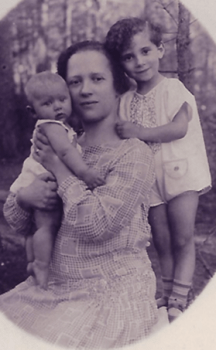
At an unknown date, prior to 1924, Mindel and Yosef’s eldest son, Machel married Chaia Judkowicz (Hannah Rouchal). On the 8th of July, 1924 they had their first child Rifka Olej. Their second and last child, Masha, was born on the 12th of March 1928.[xxiii]
Sara Olej described their children:
Rifka was very smart. “She started to talk when she was just 10 months old. She loved my father [Yosef] very much. She used to [sit] at his bed when he was sick.” Masha was blond and had blue eyes, she was “pretty like a doll”.[xxiv]

In 1924 Yosef got Arteriosclerosis and could no longer work. To make ends meet, Machel took over the barbershop and Abe would send money from Chicago. Yosef asked his son Leon, who was 16 years old to join his brother at the shop. However, Leon had other ideas. He saved up 500 Zlotys and went to Lodz to train as a beautician. When Leon returned, he took over half the Barber Shop turning it into a Beauty Parlor. With their combined income, they were able to write to Abe to tell him that they no longer needed him to send money.[xxv] [xxvi]
In 1926, Yosef and Mindel would once again get to see their son, Abe, who returned from Chicago to marry his cousin Lifcha.[xxvii] Lifcha was the daughter of Isaac Olej (Yosef’s younger brother). They would have 3 children starting with Julius Leon Olive on the 31st of October 1929.[xxviii]
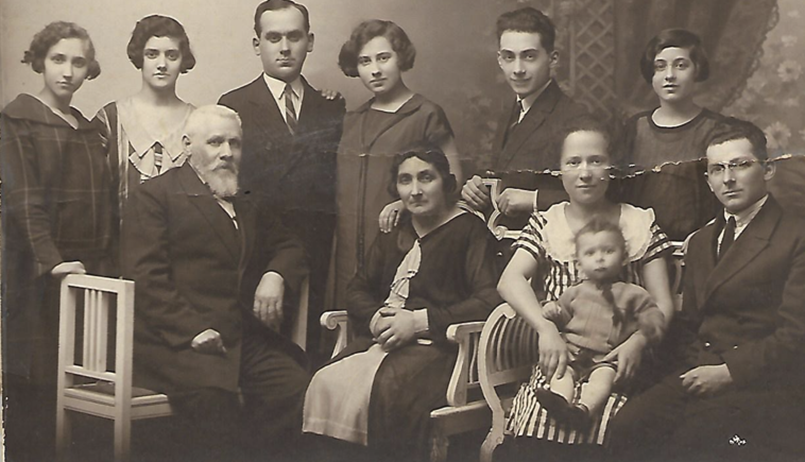
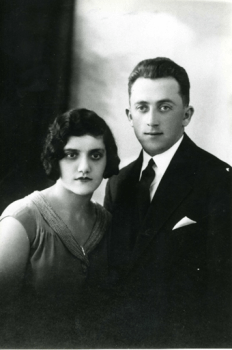
Yosef Olej passed away on the 4th of October 1928 after a long struggle with his illness.[xxix] Given his popularity, there was a big funeral. In fact, his funeral was attended by both Jews and Christians. This left Mindel, Leon, Bella, Sara and Ester Olej in the family house. [xxx] On the 3rd of January 1931, the house lost one more, but this time for a happy reason. Bella Olej married Jaco Ika.[xxxi]
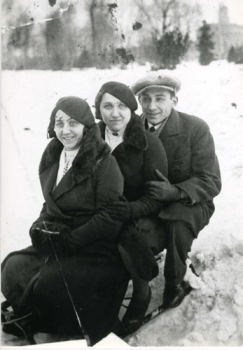
Final Departures
The 1930s saw a further increase in antisemitism, when Christians started beating up Jewish students. The situation became personal for Leon Olej in 1933. Due to a boycott in place, one of his customers, a teacher, came to his shop and said, “Leon I can’t come to you anymore, not that I don’t like you and not that I hate the Jews, but in my position, I cannot go to a Jew.” A few days later, another customer, a 17–18-year-old girl came in crying. She had been beaten by her father for the crime of going to a Jewish hairdresser.
Leon also saw turmoil outside of his shop:
A Jew had a weaving factory with Christian workers but needed more workers. 200 people were working and the factory wanted to hire four Jews, because Jews couldn’t get any work. The whole factory went on strike; they didn’t want any Jews working with them. It lasted two weeks, but in the end, they gave in and let the Jews stay.[xxxii]
Those incidents hurt so much that Leon decided to leave Poland. He recounts, “I didn’t care where, but I had to go.” When asked if he was leaving because of losing customers, Leon stated “No”, it was “the insult of it.”
Eventually Leon found a religious organization called Misraki. They told him that for $1600 they could sneak him into Palestine. That was too much for Leon to handle on his own, fortunately his older brother, Abe, was able to send him $600. Once he secured the funds he applied for and was granted permission to go on a “Mediterranean Cruise.” After taking an 18-hour train ride to Trieste Italy, Leon boarded a ship named “Gerusalemme.”[xxxiii]
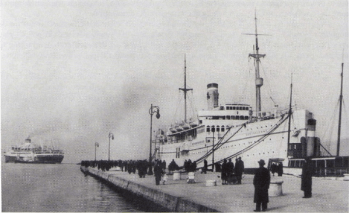
The trip started out well. Leon said that: “it was a nice voyage.” However, upon arriving in Jaffa, they were told that the British Police who had been paid off, were not at the port. Therefore, the 27 Jewish passengers had to hide. The conditions were difficult, “there was no light, no windows and the heat was unbelievable,” Leon said. After 24 hours, the boat returned and the paid-off police were where they should be. Leon, dressed as a sailor was allowed to leave the boat.
As he exited, an Arab policeman began to question him. Not knowing the language, Leon looked at him very seriously and said the one word in Italian that he knew, “debordo!” This is how he entered Palestine in 1934.[xxxiv]
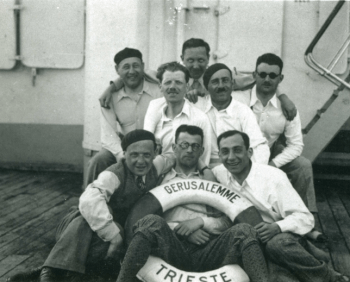
Leon went directly to Tel Aviv, where he was able to secure work at a beauty shop. His first priority was to bring his family to Palestine. It was not easy. Palestine was a foreign land for Leon. He did not speak Hebrew; therefore, communications were challenging.
Ever resourceful, Leon was able to find a Yemenite Jew, named Majer Mizrachi, who was born and lived in Palestine. The plan was for Majer to go to Poland and marry Sara. Once married, Majer could ask for his mother-in-law to join him.
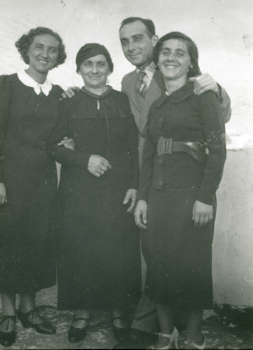
With the help of his brother Abe, Leon was able to round up the funds. Majer went to Poland, but when he arrived, he got sick and was bedridden for four weeks. This was a problem as they could not effectively communicate with Majer who only spoke Hebrew and Arabic. Eventually they found a doctor who helped bridge the communication gap. On the 17th of February 1935, Sara and Majer got married and returned to Palestine.
Once back, Leon had Majer sign a formal request for his mother-in-law, Mindel, to come to Palestine. To bring Esther with Mindel, they claimed that she was under the age of 18, though in truth she was 20. Fortunately, Mindel’s Visa, which included Esther, was approved . Once all were in Palestine, Majer reluctantly granted the divorce and Mindel, Leon, Sara and Ester were free to make a life in Palestine. Unfortunately, Mindel was the only one of Moshe Yosef and Masza Levin’s six children to make it out of Poland. We will return to the Levins in Part V.
[1] Names in parenthesis as recorded in Poland.
[2] It is not fully clear if they are the same site.
[3] Hebrew for “room”. It is a religious school.
[4] This is mostly provided as written, nothing that Leon Olive’s first language was not English.
[5] It is not clear if this was 1913 or 1916, there is data that indicates both dates.
[6] See chapter 9 for more details on Abe’s and the rest of the Saltz’s journey to the Americas.
[i] Marriage record for “Josek Lajzer Olej” and “Mindla Lewin” Vital Records, AP Lodz, Pabianice, Marriage record, (https://metryki.genbaza.pl/genbaza,detail,278415,174), translated by Petje, Original source, State Archives of Lodz. Stored on Spreadsheet housed in WordPress. Image 172, record date, 23 Jan 1890.
[ii] Leon Olive and Sara Olive’s memoirs. See Appendix C. Sara stated that Yosef was taking into the army at the age of 21.
[iii] Interview with Leon and Cypora, conducted by Silvana Olive. Partial transcript in Appendix D. Quote: to be a Felczer was not enough, you had to have a barber shop.
[iv] Sara Olive’s memoir, see appendix C.
[v] IBID
[vi] Death record for “Michal Olej”, listing his date of birth, Vital Records, AP Lodz, Pabianice, (https://metryki.genbaza.pl/genbaza,detail,300190,96), translated by Petje, Original source, State Archives of Lodz. Stored on Spreadsheet housed in WordPress. Image 94, record date, 4 Jul 1937.
[vii] Sara Olive’s memoir, see appendix C.
[viii] Leon Olive and Sara Olive’s memoirs. See Appendix C.
[ix] IBID
[x] IBID
[xi] IBID
[xii] Obtained by Keith Olive through interviewing cousins, aunts, uncles, and his parents. Provided to Sean Logan via a handwritten family tree. Remains in the possession of Sean Logan.
[xiii] A People at Risk | Polish/Russian | Immigration and Relocation in U.S. History | Classroom Materials at the Library of Congress | Library of Congress
[xiv] Interview with Leon and Cypora, conducted by Silvana Olive. Partial transcript in Appendix D
[xv] Interview with Leon and Cypora, conducted by Silvana Olive. Partial transcript in Appendix D
[xvi] Sara Olive’s memoir, see appendix C.
[xvii] “1920 United States Federal Census”, database and image at Ancestry.com, The National Archives At Fort Worth; Forth Worth, TX; Declarations of Intention For Citizenship, 1906-1974; Names: Olive, Benjamin and Sara, Place: San Antonia, Texas, Accessed 8 Jun 2025.
[xviii] Leon Olive and Sara Olive’s memoirs. See Appendix C.
[xix] A Brief Timeline of Modern Polish History – Polish-American Relations, 1918 to Present: Manuscript Resources at the Library of Congress – Research Guides at Library of Congress
[xx] Russo-Polish War | History, Facts, & Significance | Britannica
[xxi] Sara Olive’s memoir, see appendix C.
[xxii] “Texas, U.S., Naturalization Records, 1852-1991”, database and image at Ancestry.com, Fourteenth Census of the United States, 1920. (NARA microfilm publication T625, 2076 rolls). Records of the Bureau of the Census, Record Group 29. National Archives, Washington, D.C.; Name: Abe Olive, Relationship: Boarder, Place: District 0639, Chicago, Cook, Illinois, Accessed 8 Jun 2025.
[xxiii] Book of permanent Residents listing “Michal Olej” and family, translated by Petje, Original source, Books of permanent Residents, Pabianice, Vol 3296, Mortgage No 648, Page 146, Stored on Spreadsheet, link in WordPress, Name: Michal Olej, wife Chaja Ruchla Olej, 2 children, location – Pabianice.
[xxiv] Sara Olive’s memoir, see appendix C.
[xxv] Interview with Leon and Cypora, conducted by Silvana Olive. Partial transcript in Appendix D.
[xxvi] Leon Olive and Sara Olive’s memoirs. See Appendix C.
[xxvii] Story provided by Abe’s nephew, Ben Eber.
[xxviii] “U.S., Social Security Applications and Claims Index, 1936-2007“, database at Ancestry.comriginal data: Social Security Applications and Claims, 1936-2007.; Name: Julius Leon Olive, Birth Place: Chicago, Illinois, Names his parents as Abe and Lilian Olive, Accessed 8 Jun 2025.
[xxix] Death record for “Josek Lajzer Olej,” Vital Records, AP Lodz, Pabianice, Death record, (https://metryki.genbaza.pl/genbaza,detail,314075,7), translated by Petje, Original source, State Archives of Lodz. Stored on Spreadsheet housed in WordPress. Image 6, record date, 4 Apr 1928.
[xxx] Leon Olive and Sara Olive’s memoirs. See Appendix C.
[xxxi] Marriage record for “Bajla Olej” and “Jakob Lajb Ikka” Vital Records, AP Lodz, Pabianice, Marriage record, (https://metryki.genbaza.pl/genbaza,detail,314070,95), translated by Petje, Original source, State Archives of Lodz. Stored on Spreadsheet housed in WordPress. Image 94, record date, 3 Jan 1931.
[xxxii] Interview with Leon and Cypora, conducted by Silvana Olive. Partial transcript in Appendix D.
[xxxiii] IBID and Leon Olive and Sara Olive’s memoirs. See Appendix C.
[xxxiv] IBID
 Becoming Us