


The blessed Lord should help that we see each other soon in a good state. I am kissing my dear grandchildren from afar.
Kalman Besser- 1939
Fond memories of Warsaw and Otwock
The date of Kalman Besser’s and Frayda Popaver’s wedding is not known but probably occurred around 1905.[i] Once married, they lived in a large apartment that sat atop their warehouse on Rymarska Street, in Warsaw Poland. All who were interviewed for this book made particular note of their very large dining room table. This table played host to their large family, many guests, and visiting Aleksander Rebbes.[ii]
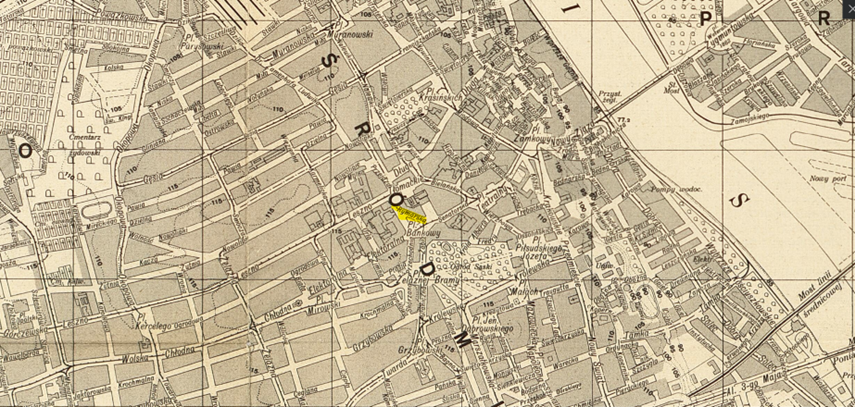
Thanks to the many hours devoted to managing their wholesale grocery store, Kalman and Frayda were able to afford such a large apartment. Despite this devotion to their business, their children recalled Frayda as being warm, loving and devoted. She always had time to make sure her children had breakfast in the morning and took their lunch to school. Kalman also was loved by the family who respected his wisdom and intelligence.[iii] Kalman was very involved within the Aleksander Hassidic community and was an admired local leader.
Founded by Rabbi Yichiel Dancyger, from Aleksandrow, Lodzki, Poland, in the early 1900s, Aleksander was the second-largest Hasidic group in Poland. Followers of the rebbes from Aleksander were primarily merchants and artisans. The Aleksander teachings stressed ethics, and joyful worship.[iv] From what this author has heard, ethics and joy would have been a good description of Frayda and Kalman.

From approximately 1907 to 1921, Kalman and Frayda would have 6 children, Sonia (~1907), Yichiel (~1913), Pola (~1914), Cypora (1915), Shraga (~1917), and Rose (~1921).[v] Though large, this was a very close family. Cypora recalled doing her homework with siblings and helping each other at that large dining room table. They were also close with their extended family. In the summer they would go on vacation to the resort town of Otwock. There they would visit Frayda’s mother Rachel and Fraydas siblings, likely Nomi among others. While in Otwock, the grandchildren would look forward to working in their grandmother’s store. Kalman was also close to his siblings. They often would come to him for advice, and sometimes financial assistance.
Growing up, Kalman’s and Frayda’s children were educated in a “Gymnasium.” This is a bit of a surprise given Kalman’s and Frayda’s strong ties to their religious community. However, Kalman reasoned that “we live in Poland and must understand perfectly the language and culture.” In the end, their focus on education saved three of their children.[vi]
There should be no mistake, however, that following proper religious traditions was also very important. Being Hassidic, the men would go to a shtibel for prayer and study. Frayda would take her daughters to the Nozyk Synagogue, which is the only synagogue left standing after World War II. Their adherence to these traditions (and a comfortable house) was a primary reason that visiting Rebbes would stay with Kalman and Frayda.

In 1925, their family grew larger when Sonia married Yitzhak Ziskind. In 1927, Sonia and Yitzhak had a daughter named Rena. Shortly after this birth, they moved to Grodzusk, a smaller town west of Warsaw. It is here that they had a son named Abram in 1931.[vii] Distance did not prevent the family from remaining close. They often visited each other both in Grodusk and in Warsaw. Reina and Abram loved visiting their grandparents and would hide when it was time to leave. Your author can recall trying to do the same when visiting his grandparents’ house!

Returning to the promised land
Though not popular among the Hassidic community, Zionism was a rising force among Warsaw Jews. It started after Great Britain captured Jerusalem from the Ottoman Empire in 1917. One of the results was the Balfour Declaration which promised a Jewish homeland.[viii]
This led to a slow uptick in Jewish immigration through the 1920s. Kalman’s sister, Rachel (known to her friends and family as Checha Rucha), with her husband, Chanoch Wasserzg, and their ten children decided to take the long trip from Warsaw to Tel Aviv. Chanoch did not survive the journey, but Rachel opened a hat shop and was able to support her family. In 1930, Rachel’s mother, Menucha, came to visit them in Tel Aviv.[ix]
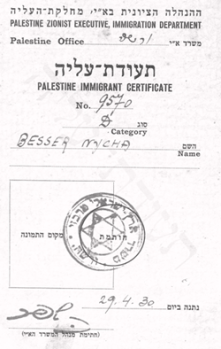
The rise of the Nazi party in Germany, significantly increased Jewish demand for immigration into the British Mandate of Palestine. Yichiel Besser was one of those who wished to leave. As a result, he withdrew from the Hasidic community and even went to a Misngdim meeting place to learn Hebrew. Pinchas Aharon Hacohen Grofman was his teacher. Pinchas studied at the famous Tachkemoni Seminary in Warsaw. After graduating he stayed in Warsaw and made a living as a teacher.
Over time, Yichiel became passionate about facilitating a move to Palestine for himself and his family. Even though Pinchas was a Rabbi within the Misnagdim movement (which opposed the rise of Hasidism), Yichiel was able to convince Kalman to allow Pola and Cypora to join his Hebrew lessons. During these lessons Pinchas and Pola became close, and “over time the friendship” between Pola (who he called Rivka) and Pinchas “met [his] desire and well wished target.” They got married.[x]
Thanks to their natural intelligence and strong educational upbringing, both Cypora and Pola were accepted to the University of Jerusalem. This was critical as demand for immigration had surpassed allowances by the British. Frayda and Kalman, however were reluctant to allow all three of their children to go at the same time. Therefore, Yicheal went first as a pioneer. Cypora used that time to study and pass the Hebrew test.[xi]
In November of that same year, for the first time ever, Cypora left her family and, on her own, took a train to the port town of Constanta, Romania. There she boarded a ship to Haifa. Upon arrival she took a train to Tel-Aviv where she was met by her sister-in-law, Hela, who recently married Yichiel. In December, they were joined by Pola and Pinchas Grofman.[xii]
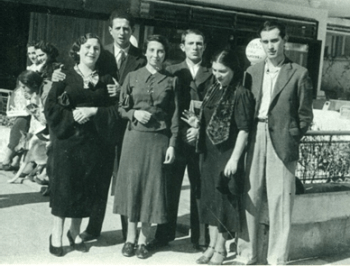

At the time of their arrival, Tel-Aviv was still emerging from the desert. It was simple and therefore, life for the siblings was simple as well. For fun they would go to the beach, play cards, and if a friend had a record player it was a party. Being single, Cypora would alternate living in Pola’s and Yichiel’s flats. Though simple, Cypora often would say that her twenty years in Israel were the best years of her life. Pola, on the other hand, found the adjustment from a life of luxury in Warsaw to a one of struggle, difficult. Resources were tight, but Pola was resourceful and always made sure that all were fed.
Angered by increased immigration and a desire for self-rule, Palestinian Arabs revolted in 1936. Cypora, who had to take leave the university to take a job at a cigarette factory due to tight finances, recalled her factory being surrounded by Arabs. It was a dangerous situation, and British Police were required to escort all the workers back to Tel-Aviv.
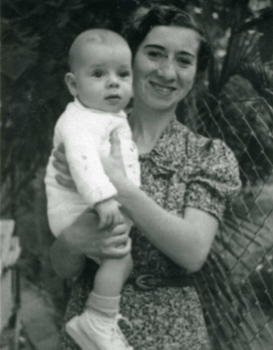
In 1937, the Besser children in Israel began having children of their own. First Yichiel and Hela had a daughter named Menucha. In that same year, Pola and Pinchas welcomed Shlomo into their family. Adding to their joy, in that same year, Cypora’s friend, Sarah Olej, introduced Cypora to her “famous and good looking” brother, Leon, at a dance. This relationship quickly turned to love, and a wedding was planned for the 4th of June 1939. Cypora and Sarah remained close friends and sisters for the rest of their lives.
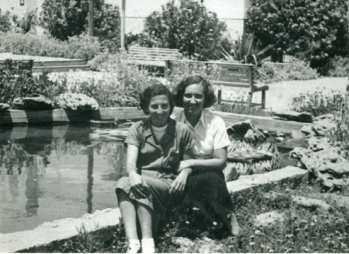
A Joyful union
Word of this union made its way to Warsaw. Kalman first wrote: “In honor of the young man Aryeh (Leon), and his family, may they live and be well.” He then expresses his disappointment that they were too far away and could not meet Leon prior to the wedding, though Kalman was relieved that he had “a sister (Rachel) upon whom I can depend.” Writing directly to Leon, he expressed concerns with his chosen profession. He also encouraged Leon to look to Pinchas for guidance on how to lead “a pure Jewish life, as I don’t believe that my dear daughter will be able to bear it any other way than what she witnessed” growing up. Assuring Leon that Kalman was not a “fanatical person,” he asked that he write back to advise if he can undertake this request.[xiii]
Cypora and Leon did reassure Kalman that they intended to lead a pure Jewish lifestyle and Kalman advised that he was going to hold “on to your letter as a reminder that you promised me [of this].” With that settled, they moved onto the next concern, Leon’s job and finances. Kalman expressed concern that up until this time half of Leon’s income was going to his “household,” likely to Mindel, Sara and Ester . Kalman asked that Leon’s mother, Mindel Levin, write back expressing support of this marriage, with the goal of avoiding any future disputes. Frayda was more direct, stating that she was concerned that Leon’s job at the beauty shop required that he work on the Sabath. “By us in Poland one must not desecrate the Sabbath for one’s job.” Both Kalman and Frayda showed clear frustration that they were so far away and wanted as many details as they could get.[xiv]
As the date got closer, Cypora’s siblings in Poland wrote to express their love and best wishes. Shraga, wished the bride and groom to grow older together, “until 120 years.” He also asked Cypora, “that you remember me at the wedding canopy.” Rose offered Cypora “Mazal-Tov,” and that God would give Cypora “health and happiness on your new path.” She also sent her best wishes to Pola, Pinchus, Yichiel, Hala, and Menucha.[xv]
Kalman Besser went to Lodz and met with Leon’s brother Machel and one of his uncles, likely Mordka Volv Olej (though Shlomo Levin is another possibility). It must have gone well since Kalman blessed the union. They heard from their cousins Chanina and Fela (daughters of Nomi Popaver and Pinchas Felner), offering Mozel-tov and requesting pictures from the wedding.
On the 4th of June Cypora and Leon were married on the roof of their Aunt Rachel Besser’s house. Yichiel made sure it was special by decorating the roof. This celebration was attended by Bessers, Grofmans, Olejs, a Levin and many friends.

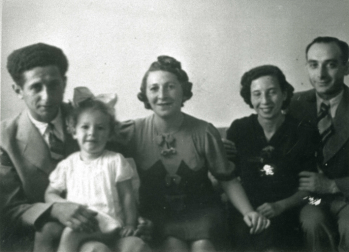


On August 30th, Cypora, Pola and Yichiel received their 2nd to last letter from their parents, this one from Kalman. Two days later Germany invaded Poland and the last letter came from the Red Cross and has been lost to time. The transcription and translation of Kalman’s letter follows:
With God’s help
Wednesday of the week of Torah portion Ki Teitzei, 1939, here in Warsaw
To my dear children and sons-in-law, daughters-in-law, and grandchildren – may you live [and be well]:
We happened to receive your letter on the holy Sabbath. I don’t want to thank you for the Tzitzit [i.e. ritual fringes traditionally worn by Jewish males], but I am very glad. Now, I have heartache/ I am pained about your earning [so] little. But the blessed Lord will not forsake you. Indeed, a new year is coming. I thank you for the Mazel Tov [Congratulations]. The blessed Lord should help you, if the Lord wills it that we merit to see [long] years with your daughter, as with you and your wife, who will be accompanying your daughter to the bridal canopy. Bridegroom Pinchas and Pesa-le – I am very much thinking over that which you write regarding the many various reasons why Pesa-le looks the way she does. Having said that, I ask that you write me what the reasons are. I am thinking this over a great deal. [A few words have been blacked out here.] Now, write me of the situation in the country [i.e., in Palestine]. I am very unhappy when I read in the newspaper what is happening there and I suffer greatly from this. I thank you very much for the Mazel Tov. May the blessed Lord help that you merit to accompany Shloimele to the bridal canopy, and may everyone be happy; you, as well. And with regard to that which you write, that Pinchas should go for 10 days to a guesthouse, it would happen right away.
By us there is no news. Praised be the blessed Lord for this and the rest. You know about the pages; now bridegroom Aryeh [word unclear] Tzipora-le. I received 2 letters from you this week: one letter on the holy Sabbath and one letter yesterday.
I thank you for wishing [me?] a Mazel Tov. If God wills it, may you have happy occasions. I am very glad that you write that you are living happily. But I would like to see that with my own eyes. If the blessed Lord helps me, such that I merit to see that, then I will praise [Him]. There is no news by us. I am sending regards to you all and long greatly for you; and wish you well-being, livelihood, success, grace, and to hear good tidings. I kiss my dear grandchildren from afar.
Kalman Besser
[i] Based on the birth dates of their children
[ii] Pinchas Grofman’s speech for his and his wife, Pola’s 50th wedding anniversary. Translated for the author by Yaron Grofman.
[iii] Cypora Olive’s memoir, daughter of Kalman and Frayda, see appendix B.
[iv] Aleksander (Hasidic dynasty) – Wikipedia
[v] Dates provided to the family by Cypora Besser
[vi] Interview with Pola Besser’s children, Shlomo, Yehuda and Aliza.
[vii] Cypora Olive’s memoir, daughter of Kalman and Frayda, see appendix B.
[viii] Britannica, “World War I and after, in Palestine,” available online at Palestine – British Mandate, Zionism, Conflict | Britannica.
[ix] Interviews with Rachel’s cousins who knew her in Israel.
[x] Pinchas Grofman’s 50th wedding anniversary speech to his family. In the possession and translated by Yaron Grofman, his grandson.
[xi] Cypora Olive’s memoir, daughter of Kalman and Frayda, see appendix B.
[xii] Cypora Olive’s memoir, daughter of Kalman and Frayda, see appendix B.
[xiii] Letters from Kalman, Frayda and family to their children in the British Mandate of Palestine, in 1939. Originals written in Yiddish and Polish and were transcribed and translated. Transcription in Appendix G “1939 Letters from Kalman and family.”
[xiv] IBID
[xv] IBID
 Becoming Us