

Invasion
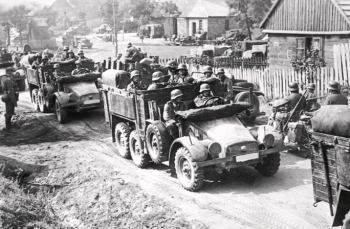
On the first of September 1939, Germany launched a massive, unprovoked attack against Poland. To overwhelm the Polish army, Germany deployed 60 divisions, 1,300 airplanes, and thousands of tanks, supported by nearly 1.5 million men in total.[i] Poland had little chance to resist.
In Pabianice, the markets were full and the preparations were made to greet the Sabath. All seemed normal, until noon when the German air force dropped their first bombs.[ii]
It only took seven days until Germany claimed the entire Łódź Viovodeship (Province). They renamed the city of Łódź to Litzmannstadt.[iii] Atrocities started immediately upon their arrival, when the German soldiers shot several Jews in Pabianice.
The same day that Łódź fell, German tanks encircled the Polish capital of Warsaw. Against all odds, the Warsaw garrison repelled three major attacks.[iv] Frustrated with this failure, Adolf Hitler ordered a major bombing campaign on the city, targeting civilians. Polish composer Wladyslaw Szpilman recalled “the noise of explosions merged with the constant thunder of guns, penetrated by the boom of nose-diving aircraft like electric drills boring holes in iron.”[v]
All went from bad to horrible when on the 17th of September, the Soviet Union invaded eastern Poland. Then on the 28th of September 1939, Warsaw officially surrendered. Germany and the Soviet Union portioned Poland with Warsaw and the Łódź region under German control. Over 20,000 civilians were killed. For those that remained, the nightmare had just begun.[vi]
Immediate impact
At the time of the invasion, there were approximately 160 people related to your author living in Poland (see part IV for those that left). Two managed to escape east into Russia. They were Mordechi and Eliezer Olej, sons of Machel Olej and Hannah Leya.[1] Eliezer made it all the way into Russia proper where he was safe until the end of the war. Unfortunately, for reasons unknown, he could not bring his wife, Malka (daughter of Modka-Volv Olej) and their two children, Isaac and Micheal. After the war he made it to Israel and was a writer.[vii]
Eliezer’s brother, Mordechi traveled 375 kilometers east into Bialystok. On his first night in Bailystok, 14th of September, he had a dream that his mother, Hannah Leah, told him to leave at once. Fortunately, he listened as Bialystok was captured on the 15th by Nazi Germany.[viii] It is not known how, but Mordechi Olej eventually made his way to Israel.[ix]
Moshe Yosef and Masza Levin’s daughter Zisa Rajzla Levin lived in Pabianice with her husband, Abram Moshe Edelsztajn. On the 4th of September 1939 Abram Moshe passed away at the age of 72.[x] It is not known if the invasion caused his death. Their daughter, Hinda Edelsztajn either escaped during the invasion or had immigrated to Israel prior.[xi] Zisa Rajzla and Abram Moshe’s 7 other children were stuck in Poland.
Who Remained
Below you will find an incomplete list of our relatives that were stuck in Poland. There is no way to know for sure where everyone was, therefore, the section below provides a look at the last known location of our relatives, and a reasonable assumption of where they ended up.
Zdunska Wola
Most of Isaac Olej’s and Sara Pik’s children were able to leave Poland prior to the Nazi Invasion. In a sad twist of fate, their daughter Devora returned to Poland from the USA with her husband and son in 1938. They were believed to be within or near Zdunska Wola during the invasion. The fate of Esther, Pesa, Rachel and Chana is not known.
Berish Olej and Ajdla Goldberg had six children who survived to become adults. Two of their children left prior to the Nazi invasion. Manya, and Avram Moshe were in Poland during the invasion. The fate of Luba is unknown. It is not known when or who, but it appears that their daughter Cerla was able to make it to Belgium, much like her sister Bajla. Unlike Baijla she was eventually caught, which will be discussed later.
Łódź
Aharon Mayer’s daughter, Shayna Rashel and most of her family were believed to be living in Lodz on Drewnowska Street at the time of the invasion. Isaac’s and Berish’s half-brother, Mordka Volv Married Brajdla Pozgowicz in 1906. The two of them and at least two daughters survivied the Nazi Invasion of Poland. Their daughters were Estera Malka[xii] and Rajzla. It is possible that they also had the following children, whose fate is not known: Avram Moshe, Chaskiel, and Golda.
Łask
As discussed in chapter ten, Aharon Mayer Olej’s son, Jacob Isaac left Poland in 1922. Between his two wives, Ruchla and Reina Wajc, he had nine other children, born between 1868 and 1888. Three died before becoming adults. Of the remaining six, Glikel Rakhel and Machal survived the invasion of Poland. The fate of Yehoshua, Eliezer, and Shimoo is not known. It is rumored that Eliezer made it to the USA, but this is not confirmed.
Aharon Mayer’s brother, Machel Olej had ten children with Hanna Leya. Three passed prior to reaching the age of two and three escaped. Chaja Bina, Szyja, Ichack, and Jakow were believed to have been living within or near Łask during the invasion. The fate of Mackla and Hercke remain unknown.
Pabianice
During the invasion of Poland, Pabianice was home to a large amount of our relatives. Many of Yosef Olej’s and Mindel Levin’s children had left prior to the invasion. Their son Machel passed in 1938, but he was survived by his wife Chaia Judowicz and their two children, Rifka and Masha. Their daughter Bella decided to leave in 1938, but by then it was too late and she was stuck in Poland with her husband Jacob Ika during the invasion.
Mindel Levin was the only one of her siblings to make it out of Poland prior to the invasion. This left Zysa Rajzla, Lajb Levin, Fajga “Hia” Levin, Benyaman Levin, and Shlomo Mendel Levin. Hia died around 1915, she was survived by her husband Mendle Heliskowski who died in 1935. They both were survived by their four children. The fate of Lajb is not known. The rest of Mindel’s siblings and their family were believed to have experienced the invasion of Poland, likely in Pabianice.
One person did escape. She was Hinda (Levin) Shabat, daughter of Zysa Rajzla. Her story is not known but she did make it to Israel, married Mamer Shabat and in 1940 had a daughter Miriam. It is Hinda who recorded the fate of her siblings and parents.
Warsaw
Only one of Menucha and Avram Zamvel Besser’s eight children, Rachel, left Poland prior to the invasion. Kalman, Freyda, Leya and Gitel and their families were believed to have survived the siege of Warsaw. The fate of Moshe, Yitzhak and Shayona is unknown.
Three of Kalman Besser’s and his wife Frayda Popaver’s children were living in the British Mandate of Palestine. Their remaining children, Shraga, Sonia and Rose also survived the siege of Warsaw.
The only other child of Menucha and Avram Zamve that we know for sure had children was Giteal. They were Moshe and Reina. Their fate is not known.
Otwock
Frayda Popaver’s Mother Rakhel (last name unknown) was believed to have been living in Otwock during the invasion of Poland. None of her children left prior. Frayda was in Warsaw. Naomi, Isaac, Rosa and Avraham Popaver’s exact status is not known but based on Cypora’s diary it is believed that they and their family were in Otwock or the Warsaw area at the time of the invasion.
[1] See chapter 10: Escaping Antisemitism in Zdunska-Wola
[i] Holocaust Encyclopedia, “Invasion of Poland, Fall 1939,” available online at (Invasion of Poland, Fall 1939 | Holocaust Encyclopedia)
[ii] Jakob Grynsztejn, “A Partisan from Pabianice in the Forests of Belarus,” his memoir, sections available online at Jewish Gen: https://www.jewishgen.org/Yizkor/Pabianice1/pab188.html.
[iii] Holocaust Encyclopedia, “Lodz,” available online at (Łódź | Holocaust Encyclopedia)
[iv] The National WW II Museum, New Orleands, “The Invasion of Poland,” available online at: (The Invasion of Poland)
[v] IBID
[vi] IBID
[vii] Story from Sara Olej relayed to Judith Silberg from Ben Eber on 4 Jan 1997, letter in the possession of the Author.
[viii] Holocaust Encyclopedia, “Soviet and German Occupation of Bialystok”, available online at: Bialystok | Holocaust Encyclopedia
[ix] Story from Sara Olej relayed to Judith Silberg from Ben Eber on 4 Jan 1997, letter in the possession of the Author.
[x] Metryki Gen Baza Poland, AP Lodz 39, Pabianice Moj 1616, death record, Abram Mordka Edelsztajn, 4 Sep 1939, Pabianice, age 72, available online at: GenBaza Metrics – Registry and Registry Books. Genealogy., translated and transcribed by Petje, see appendix E.
[xi] Yad Vashem, entries by Hinda Shabat, nee Edelsztajn, living in Israel at that time, entries available online at: https://collections.yadvashem.org/en/names/search-results?page=1&s_submitter_fn_search_en=Hinda&t_submitter_fn_search_en=yvSynonym&s_submitter_ln_search_en=Shabat&t_submitter_ln_search_en=yvSynonym.
[xii] Obtained by Keith Olive through interviewing cousins, aunts, uncles, and his parents. Provided to Sean Logan via a handwritten family tree. Remains in the possession of Sean Logan.
 Becoming Us