

Becoming Logan and Gard
Chapter Six: Going to Missouri
1700 – 1842
William Logan Jr; Martha “Patsy” Hudgens and her ancestors:
Daniel Hudgens, Dorthy McNeely, Moses Hudgens (and potential relations)

William, son of William
Thanks to the Census, we know that William and Agnes Logan (nee McNown) welcomed their son and our ancestor William (jr.) into Logan’s Station (St. Asaph) sometime in the 1780s[i]. While Lincoln County was establishing itself as a thriving community, it was also still firmly on the frontier of a growing nation. This westward growth was not into a baren wilderness, but was into existing nations, who were not at all happy about it.
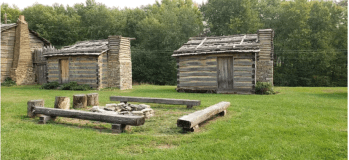
While we have no specific records for what life was like for a young William (jr.) Logan, we get a sense of the tension from a Kentucky Gazette article about Francis Dowing who lived in a fort in KY as a “lad”[ii]. The article describes a time when he and a young man called Yates were 6-8 miles away, searching for a stray horse when Francis heard a noise “like sticks cracking”. When he expressed his concern, Yates called him a coward. It turned out Francis was right to be worried as “within a few minutes an Indian was seen”. He and Yates took off on a run and may have been caught if it was not for the fact that they came upon a mama Bear who was quite annoyed at this intrusion. Fortunately for them, her anger was focused on the attacking “Indians” allowing them to escape back to the safe confines of the fort. From other accounts we get a sense of wildlife. A surveying mission describes seeing hundreds of Buffaloes, Elk and Deer, oh and 15 Native Americans hiding.
In response to this risk, William (jr.’s) uncle, Benjamin Logan was a member of a board that empowered Brigadier General Scott to raise a militia “not exceeding 326 privates” and to “station them on the frontiers in such manner he may think most conductive to the public safety.”[i] This militia had several engagements but did not put an end to the conflict which continued through the war of 1812.
1792 represented a large milestone for the citizens of Kentucky when their first governor, Isaac Shelby, addressed the House and Senate laying out his priorities[ii]. These included, passing laws to ensure elections “without any kind of undue influence”. He wanted a law “obliging sheriffs and other public officers to give security for the due performance of the duties.” Finally, as a reminder of the times, he added “your humanity as well as your duty will induce you to pass laws to compel the proper treatment of slaves.” Congress provided a very political answer committing to nothing.
In 1805, now an adult, William (jr.) received his share of the probated will. In the will he received the land, “known by the name of Hicks Cabins”. He also received “one Negro girl named Esther” and 5 pounds. We don’t know what he did during the next 7 years, but in 1812 he settled down.
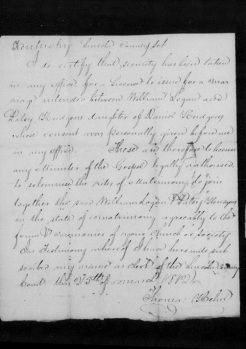
“I do certify that security has been taken in my office for a License to issue for a Marriage intended between William Logan and Patsy Hudgens, daughter of Daniel Hudgens whose consent was personally given before me in my office.” This is the opening sentence for the “Permission to Marry Document” (see fig 6) which confirms who William (jr.) married. In addition, it is the only original record we have for Patsy Hudgens. It is worth noting that are other theories regarding who Willaim married but the above document, the fact that she was living in Lincoln County KY makes me confident that we have the right couple. This marriage also brings us a new family that we should explore further.
Discussing the Hudgens
We don’t know much about Patsy other than she was born in Lincoln County to Daniel Hudgens and Dorothy “Dolly” McNeely. Therefore, to better understand who she is we must look at her ancestors.
Of Dolly McNeally[iii], who married Daniel in Lincoln County Kentucky on 10 October 1789[iv], very little is known for sure. One unconfirmed possibility is that she was born to James McNeely and Polly Workman. There is not a ton of information here, but some trees show James born in Virginia and there are records of his living in Kentucky in 1789[v], though in Madison County. These trees go on to show his father to be Robert McNeely and Grandfather to be George McNeely with George having lived in Ulster Ireland. This is very much unconfirmed and therefore could be inaccurate. However, the Ulster connection is interesting.
Before we talk about Daniel, let’s look at what we know about his ancestors. We know that Moses Hudgens was his father, thanks to his will, where he made Daniel his executor. However, it is less clear who his mother was. Of Moses, we know that he lived in Wayne County Kentucky in the early 1800s, but that is where any certainty ends. There are records of one or more Moses Hudgens living in Virginia who served as a private in the 7th regiment in the Revolutionary war[vi]. It is possible that Moses received a land grant in Kentucky and is indeed our Moses. If we are correct then Moses also signed the “Ten Thousand Name Petition” in 1776 to end the persecution of Baptists, this is viewed as a key step in the fight for religious freedom. His wife may have been Kiddyan who was on a deed for selling land[vii].
Of Moses’ parents, if we are correct about his living in Virginia, then his father was Robert Hudgens who granted Moses 5 shilling and 400 acres by patent in Cumberland County[viii]. Robert was married to Martha Parker and there is information to be had on her and her ancestors, but this is so uncertain that I leave their story for a future release or a future researcher.
The Kentucky Hudgens
Daniel Hudgens married Dolly McNeely in Lincoln County Kentucky in 1789. He is also listed in the 1790 Kentucky Census[ix]. Around 1790 they likely had their first child, there is no way to know exactly who it is, but a good guess would be Katherine “Kitty Anne” who married James Tucker, he was an administrator of Daniel’s estate (fig 7)[x]. As an aside, the name Kitty Anne, does indicate that Daniel’s mother very well may have Kiddyan. We already discussed Martha “Patsy” Hudgens. Therefore, the final child that we have documentation as being born to Daniel and Dolly is Cyrene Hudgens who married Jonathan Snowden who was also an administrator to his estate (fig 7).
I next turn to DNA[1] to identify Ballard A. Hudges as my 4th great-granduncle, and very likely, the son of Daniel and Dolly. Looking at on-line trees you will see others who are listed as being their children including Betsy, Robert, Anna, Susanna, and Prince. However, I have not been able to find anything to say that with certainty. Prince Hudgens does draw some interest. He married Nancy Logan who is the daughter of William and Martha.
We hear about Moses two more times. First in 1801 when he appears in the “Wayne County Court book A”, exempting him from paying “county levies in future on account of age and infirmity”. The second time is upon his passing in March 1811, where we see that Daniel Hudgens and Anna Hudgens are his executors. I am not sure if Anna is a second wife or a daughter of Moses. I am also not sure what was in the will as the only document I was able to find was a court order to execute the will and acknowledging that Moses has passed[xi].
Sometime between 1811 and 1830, Daniel and Dolly moved to Ray County Missouri and appeared on the 1830 US federal census. This was their final move as in 1836 we know that Daniel has passed intestate (fig 7) leaving his sons-in-law James Tucker and Jonathan Snowden to administer his estate.

William and Patsy
Let’s briefly return to Lincoln County KY where William and Patsy face the reality of the war of 1812. Once again, the foe is Great Brittian and their Native American Allies. While I cannot say for certain if William participated in the war, I able to say that at least 20 Logan’s served and likely many were descended from our very own David Logan. Of note, we see William, Benjamin, Hugh, and James Logan mentioned as soldiers, which could mean 4 brothers serve[xii].
If we have the right William he is listed as being on the Roll of Captain John Hunt’s Company, 3rd Reg, Kentucky Mounted Militia starting September 22nd 1812[xiii]. There is also another William listed as part of Captain George Matthew’s Company in August and September 26th of 1812 [xiv], and finally a William Logan who was detached from Captain Armstrong Keir’s company in 1818[xv]. Since we don’t know for sure if William (jr.) served, we will not discuss the war of 1812 any further here beyond the fact that it did mark the end of outright hostilities between the United States and the Native American in this region.
Starting in 1812, William (jr.) and Martha were also busy building their family. Thanks to his will and improved census records (starting in 1850) we can say with a high degree of certainty who their children were and when they were born. Their first child, Preston Logan was born in 1813, he became a carpenter and lived in Lakeport California[xvi]. Another William was born in 1815, I guess he would be William Jr. Jr. Martha Ann Logan was born in 1818, she married Flemming Davis who would be one of two executors to William (jr.’s) will. Nancy Logan married Prince Hudgens who was a lawyer, and given that his property was valued at 75,000 in 1860 must have done very well[xvii]. Around 1821 my ancestor Daniel H. Logan was born; he will be discussed in chapter 7. Finally, there is Joannah Logan who was born in 1827, she married Thomas Parker and later Elizah Impey[xviii].
You have probably noticed quite a few gaps in the years between their children were born. This could be because William served as a soldier in the war of 1812, taking him away from home for extended periods. It could also be due to infant mortality which as late as 1900 was 165 out of 1000, or over 16%[xix].
Going to Missouri
Sometime after birth of Joannah (1827)[xx] (1827), William (jr.) moved his family to Missouri, a territory that had spent the last ~30 years as a major power point both within and outside of the USA.
In 1800, Napolean Bonaparte, looking to revive the French Empire in the “New World, acquired Louisiana from Spain. In 1802 he attempted to take possession by sending a large arm to St. Domingue with plans to send another to New Orleans. Our 3rd President Thomas Jefferson took note and said, “There is on the globe one single spot, the possessor of which is our natural and habitual enemy. It is New Orleans”.
To prevent a war, Jefferson sent James Monroe to France with the goal of purchasing New Orleans and West Florida. Monroe being authorized to spend $10M commenced negotiations in 1803. Realizing how hard it was to retain his new possessions, Napolean surprised Monroe by offering the entire Louisiana territory for $15m. This was a deal he could not refuse, therefore in one stroke United Stated added all the land between the Mississippi River and the Rocky Mountains, or 530m acres[xxi].
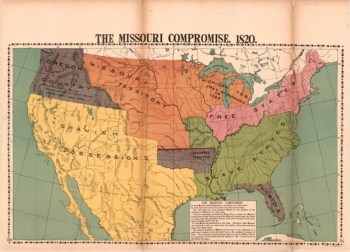
In 1812, the Territory of Missouri was established and by 1817 a petition was made to congress requesting for Missouri to become the 23rd state. This created an internal struggle since the US was equally divided between free states and slave states. Given that the legality of slavery was a major debating point, both sides were very concerned about tipping the balance of power. The result is the Missouri Compromise (figure 8) which admitted Maine as a free state, and Missouri as a Slave state. It also outlawed slavery north of the 36° 30´ latitude line in the Louisiana Territory except for the state of Missouri[xxii].
Where in Missouri they moved is of some doubt, so let’s start with what we know. Reading William (jr.’s) 1842 will, tells us that he is living in Johnson County MO[2], formed in the far northern end of what was Cooper County as shown in figure 9. Since we know he lived in Johnson County which had a population of only 4,471 people[xxiii], it is likely that the William Logan in the 1840 US federal census living in Jackson Township within Johnson County is William (jr.). Beyond this, things get a bit complicated. There is William Logan on the 1830 US Federal Census living in Ray County Missouri, which was formed on the far southern end of Howard County as shown in figure 9. There is also a land Grant for William Logan in 1731 in Clay MO, which is in the far Southern end of Ray County. As you will see later William, at this time was likely a farmer, and while Jackson Township and Clay are close, it does seems seem strange to have two different farms within such a short time.
Of note, I was not able to find any another William on the US Federal Census for 1830 at this time either in MO or KY. Also, most of his children settled in Andrew County which is North West of Howard County as shown in figure 9, giving us another location in Missouri. What to conclude? No later than 1840, William moved his family to Missouri and was a farmer. As Patsy does not appear on any census in Missouri, they either are divorced, or more likely, she passed very shortly after the birth of Joannah (maybe during birth).

With the evidence aside, we continue in 1840 within Jackson Township. William (jr.) who was between the age of 50-59[xxiv] was living with 3 other “free white persons living with him, one a male 20-29 (likely William or Preston), one female between 10 & 14 and a female between 15 & 19 (Likely Joannah and Nancy)[3]. There were also 12 slaves within his houseold, with 8 total people engaged in agriculture. I wish I could give you their names but despite trying I could not find any clues. All I can tell you is that there were 8 males (two under 10) and 4 females (1 under 10).
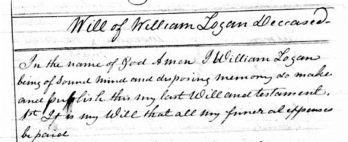
On the “fourth day of October AD 1842” Daniel Logan, son of William (jr.) came to the clerk of the Johnson County Court and presented the will of William Logan who was recently deceased[xxv]. In his will, William (jr.) left everything to his children, naming Preston Logan, Martha Ann Davis (wife of Flemming Davis), Nancy Hudgens (wife of Prince S Hudgens), and Joanah Parker (wife of Thomas F Parker) as being married. He named William Logan, Daniel Logan, and Jane Logan as unmarried. He also took a moment to specifically prevent “Thomas F Parker husband of my daughter Joanah Parker from ever inheriting or in any manner whatever possessing any part or portion of my estate, he having falsely abandoned her.” He asked Prince Hudgens to “hold and dispose of the said share of my estate for the exclusion and benefit of my said daughter Joanah Parker”. “Reposing especial trust and confidence in the honesty and integrity” he names Flemming David and Daniel Logan as executors. I will note that he does not mention slaves on the 1840 census which raises some unanswered questions.
This ends the story of William Logan (jr.) who grew up in the wilds of Kentucky and brought his family to a new frontier in Missouri. Next, we will examine the life of Daniel Logan and what it was like to live in a state with mixed loyalties during the Civil War.
Open Questions
- What was William’s occupation?
- What was he doing between 1805 and 1812?
- Was William in the army during the war of 1812?
- Do we have the correct Moses Hudgens?
- Who are Prince Hudgen’s parents?
- Are we correct about Ballard Hudgens?
- Did William (jr.) live in Ray County MO?
- Given no mention of slaves in his will do we have the 1840 census correct?
[1] Autosomal DNA test by Ancestry.com. This test identifies matches, typically from 1st to 6th cousins. You can then compare your genealogical work to theirs. In this case there was a well-researched tree that clearly showed a direct relation to Ballard Hudgens and we both have Daniel as his father. Not 100% conclusive but makes it likely.
[2] This is clearly his will as he names all of his living children.
[3] The 1830 only named the head of household and provided age ranges for the rest.
[i] Kentucky Gazette 1 June 1827
[ii] Kentucky Gazette 19 October 1827
[iii] From Ancestry “Dodd, Jordan, Comp.. Kentucky Marriages to 1850. Electronic transcription of marriage records held by the individual counties in Kentucky.”
[iv] KY US, Compiled marriages, 1802-1850 in ancestry;
[v] Kentucky, Us Compiled Census and Census Substitutes index, 1810-1890 – in Ancestry
[vi] National Archives; Washington, D.C.; Compiled Service Records of Soldiers who Served in the American Army During the Revolutionary War; Record Group Title: War Department Collection of Revolutionary War Records; Record Group Number: 93; Series Number: M881; NARA Roll Number: 1028
[vii] Virginia Deed book 4 pg 196
[viii] Cumberland County, Virgina Deed book pg 490
[ix] Ancestry.com. Kentucky, U.S., Compiled Census and Census Substitutes Index, 1787-1890
[x] Missouri, U.S. Wills and Probate Records, 1766 – 1988
[xi] Wayne County Court House Clerks Office Sate of Kentucky, Court Orders Vol. A, pg 175 – a copy held in Ancestry
[xii] Kentucky Soldiers of the War of 1812 with an added Index by Minnie S. Wilder, ref index on pg 406
[xiii] IBID pg 20
[xiv] IBID pg 101
[xv] IBID pg 191
[xvi] 1870 US Federal Census, Lakeport, Lake, California, Roll: M593_73; Page: 407A
[xvii] The National Archives in Washington D.C.; Record Group: Records of the Bureau of the Census; Record Group Number: 29; Series Number: M432; Residence Date: 1850; Home in 1850: Savannah, Andrew, Missouri; Roll: 391; Page: 60b
[xviii] Reference William’s Will held in Ancestry (Missouri, US, Wills and Probate Record, 1766-1988; and “Missouri, US, Compiled Marriages, 1754-1850 in Ancestry that shows Joana Parker marrying Elijah Impey 1 Oct 1846.
[xix] The First Measured Century: Timeline: Data – Mortality (pbs.org)
[xx] The 1850 US Federal Census has her as being 23 and born in Kentucky – Source – US Federal Centus, Year: 1850; Census Place: Savannah, Andrew, Missouri; Roll: 391; Page: 62b
[xxi] Milestones: 1801–1829 – Office of the Historian (state.gov)
[xxii] Introduction – Missouri Compromise: Primary Documents in American History – Research Guides at Library of Congress (loc.gov)
[xxiii] Johnson County population
[xxiv] All facts in the paragraph courtesy of the 1840 United States Federal Census; Year: 1840; Census Place: Jackson, Johnson, Missouri; Roll: 224; Page: 135; Family History Library Film: 0014856
[xxv] All items relating to William Logan’s will and probate from – Missouri, U.S., Wills and Probate Records, 1766-1988 Will Records, 1840-1916; Author: Missouri. Probate Court (Johnson County); Probate Place: Johnson, Missouri & Record of Sale Bills, Vol. A, 1875-1882; Author: Missouri. Probate Court (Johnson County); Probate Place: Johnson, Missouri
[i] 1830 US Federal Census Ray County Missouri; 1840 US federal Census Jackson Missouri
[ii] Kentucky Gazette 26 January 1827
 Becoming Us