

Becoming Logan and Gard
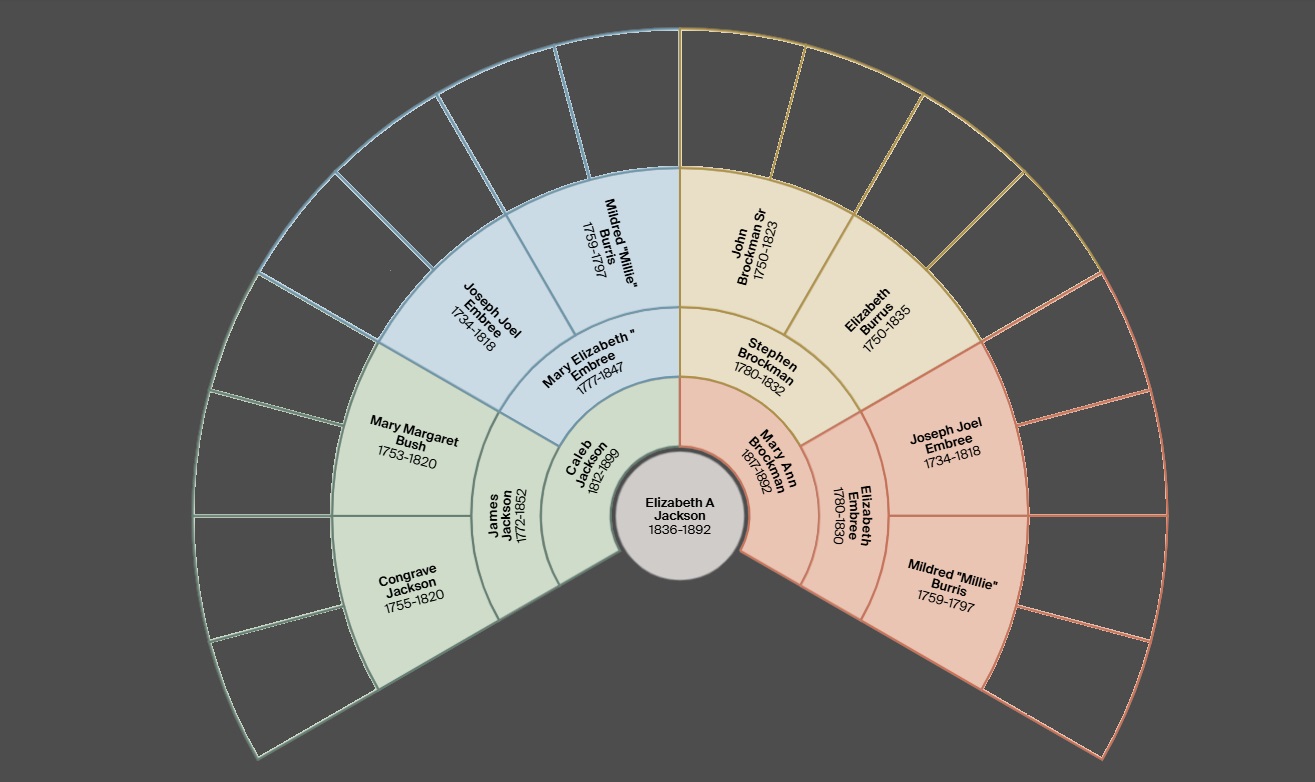
Chapter Nine: Becoming Elizabeth Jackson part 2
Colonial Kentucky and Missouri 1750 – 1860
Brockmans: John, Stephen and Marry Ann Brockman
Embree: Joseph, Elizabeth and Mary Embree
Jacksons: Congrave, James, Caleb, and Elizabeth Jackson
Bush: Margaret Bush
Burrus: Thomas and Mildred Burrus

Elizabeth’s Great Grandparents in Virginia
As a refresher, because her parents were cousins, Elizabeth’s great grandparents are as follows: Congrave Jackson and Mary Margaret Bush; Joseph Joel Embree and Mildred “Millie” Burrus; John Brockman (Sr.) and Elizabeth Burrus.
Mary Margaret Bush (who typically went by Margaret)[i] was born in 1735 to John and Martha Bush. Two years later Congrave Jackson was born to an unknown parent.[ii] In 1772 Congrave and Margaret were married in Bedford, VA.[iii] Shortly after their marriage they had their first of 8 children, James Jackson who was also Elizabeth Jackson’s grandfather.[iv] Their other children include Patsy, Temperance, Lydia, Margaret, Fanny, Suckey and Nancy.[v]
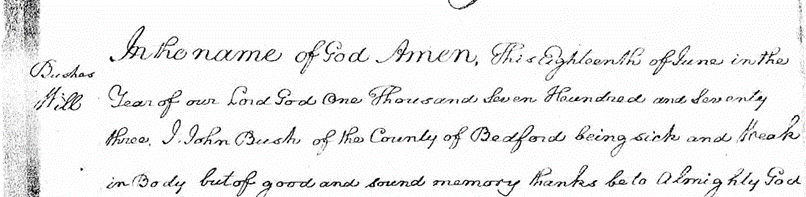
On January 1774 Margaret’s father John Bush (jr.) passed away in Bedford County Virginia.[vi] Reading his will one may conclude he was deeply religious as he opens by saying “Sorry from the Bottom of my Heart for my sins Past most Humbly desire forgiveness for the same.” He continues by committing his soul “unto almighty God my Saviour and Redeemer in whom and by the merits of Jesus Christ I trust and believe assuredly to be Saved.” He then reflects how his “Soul with my body at a General Day of the Resurrection shall rise again with Joy and through the merits of Christs death.”
His will leaves his wife Martha Bush his Estate both real and personal throughout her life of widowhood. Upon her death the estate is to be equally divided between his children “Margit Jackson, Mary Bush, Francis Bush”. He closes by appointing his wife, Martha, and son in law, Congrave Jackson as executors.[vii]
It is around this time that Elizabeth’s two other great grandmothers gave birth to her other 3 grandparents. Stephen Brockman was born to John Brockman and Elizabeth Burrus (see chapter 8), date unknown. Around 1777, Joseph Joel Embree and Millie Burrus welcomed their daughter Mary “Polly” Embree to Orange County Virginia.[viii] A few years later, between 1781 and 1785, they also welcomed Elizabeth Embree.[ix]
The Bush Settlement
The direction of all their lives was about to take a turn thanks to Margaret Bush’s cousin, William (Billy) Bush. Born in Orange County VA to Philip Bush (John Bush Sr.’s brother) and Mary (last name unknown) on 26 June 1746, he was the 10th of their 12 children.[x] He played a key role in the settlement of Kentucky.
In 1774 at the conclusion of “Lord Dunmore’s War”, the Treaty of Camp Charlotte was signed between the Colony of Virginia and the Shawnee chiefs. This treaty opened all lands south of the Ohio River for settlement.[xi] As discussed in Chapter 5, Daniel Boone led 30 axmen to cut the “Wilderness Road”[xii] which ran from the Cumberland Gap into the interior of what is now the State of Kentucky. With Daniel Boone, Billy helped build Fort Boonesborough in 1775.[xiii]
After the fort was established, to stake a claim, Billy started planting crops on the North side of the Kentucky River, in what is now the south of Clark County. On June 26’th 1775 his partner David Glass wrote to Col. William Preston (a surveyor)[1]. “Sir, I am Informed that you Take in Entries of land on ye North side of Cantucky”. “I will Trouble you once More to Ogment your favor to me so fare as to take in ye following Entrys”. “David Glass & William Bush Enters 400 Ackers more or less beginning above their spring….”.[xiv]
Billy remained very active in Kentucky and even was involved in the rescue of Daniel Boone’s daughters who were taken prisoner by 4 Shawnee and 1 Cherokee which is considered the first action of the Revolutionary War in what was then the western frontier.[xv]
Having established himself in Kentucky, Billy came back to Virginia to enlist assistance in creating his own settlement. In 1778 we find him in Orange County where at the age of 32 he married Frances Burrus aged 16. Frances is the daughter of Thomas Burrus and therefore, Millie Burrus’s and Joseph Embree’s sister.[xvi]
In 1779, the Virgina General Assembly passed a law allowing pioneers who were already in Kentucky to claim land. Billy’s approach was to form a coalition which allowed him to purchase 15,000 acres in the location that became the Bush Settlement. Joseph Embree ended up with 1000 of those acres.[xvii] There were a few other familiar names purchasing land including Thomas Burrus, Samuel Brockman Jr.

Joseph Embree and Millie Burrus must have arrived at the Bush Settlement before 1784 which is when we find Joseph as a member of the Providence Baptist Church, which at that time held service mostly in Billy’s cabin.[xviii] In 1788 he became a Deacon.[xix]
In 1795 Congrave Jackson and Billy’s cousin Margaret Bush purchased 100 acres of land from Billy Bush for $50 bringing 4 of Elizabeth’s 6 great grandparents together in the Bush Settlement.[xx]
All together in Kentucky
At this point 3 of Elizabeth’s grandparents are living in Kentucky, likely at the Bush Settlement, they are James Jackson, Mary and Elizabeth Embree. In 1796 James Jackson married Mary “Polly” Embree in Winchester KY which is 8 miles north of the Bush Settlement and the current seat of Clark County.[xxi]
This leaves one missing Grandparent, Stephen Brockman. I don’t know when he arrived, but in 1803 he married his first cousin Elizabeth Embree also in Winchester Kentucky.[xxii] Thanks to the data in the 1850 US census we know that they had their first child, Joseph around 1805. The rest of their children were (in order), Jacob, Midred, Elizabeth, William, Stephen, Emma, Mary Ann (Elizabeth Jackson’s mother), Emily, Gabriel and Attila.[xxiii]
In 1810 we find James and Polly Jackson listed on the Clark County Census with 6 sons under 10 and their daughter Nancy who is between 10-15.[xxiv] I have only been able to find the name of three of their sons, Thomas, Congrave and Caleb (Elizabeth’s father and was not born until 1812), therefore I am missing 4. In 1812, Stephen Brockman and Elizabeth Embree are listed as members of the “Old Friendship Baptist Church” which is on Strode’s Creek just north of Winchester Kentucky.[xxv]
On the 15th of July 1818, Joseph Embree began the process of disposing of his lands and assets. He is ordering that all the “negroes” and the Farm to be sold on the first day of October with the proceeds being split between his 8 children and 3 grandchildren in 9 parts, with the 3 grandchildren splitting one of the 9th. He does reserve for himself “two negroes, one called and known by the name of Benjamin a negro man and one negro woman called and known by the name Lucy.” In addition, he reserved for himself “the money I now hold in my possession, which is about one hundred and ninety dollars.” With his son Joseph Embree being a minor, he gifted him an additional 110 pounds which was to be deducted from the estate prior to it being split in 9 parts.[xxvi] I don’t know when he passed, and given that his wife, Millie is not in the will she likely passed prior to the creation of it.
In 1820, Congrave Jackson passed. Also written in 1818, his will reads “Calling to mind the Mortality of this Body and through Certainty of death whin it shall please god to call me hence do make ordain and deliver this to be my last will”. He goes on to give “to my Son James Jackson one horse and saddle & c, which he has Recd” He lists Margaret as his wife and wills her the balance of his estate for use during her natural life. After her death the estate to be sold and split evenly among his children. She passed in the same year.

Into Missouri
On the 28th of March 1824, Stephen and Elizabeth (Embree) Brockman sold 111.5 acres to John Rawling and “Mildred his wife” from Howard County Missouri. In the deed it states that their Mother Mildred (Burrus) Embree was deceased and therefore this property (the 1/9th part) has been properly inherited by them.[xxvii] This would be the last we see of Stephen and Elizabeth in Kentucky.
Sometime between that land sale and 1830 Stephen, Elizabeth and 7 of their children came to Randolph County Missouri. They appeared on the 1830 US federal Census with their daughter, Mary Ann Brockman, 6 other children and 7 slaves. It is likely given their background that they were farmers.[xxviii] They were also original members of the Renick Union Church as part of the Methodist congregation (it also served a Baptist Congregation). Other members included a Thomas and E.D.J. Brockman, I am not sure if they are a brother or cousin.[xxix]
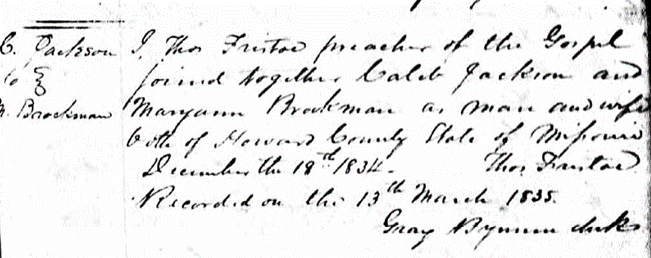
Prior to this, James Jackson had already arrived in Howard County Missouri which borders Randolph County to the south. Since his son, Thomas Jackson was married in 1824 in Howard County, it is likely they arrived prior to that date.[xxx] Whenever their arrival was, on the 18th of December 1834, his son, Caleb Jackson married Mary Ann Brockman in Howard County.[xxxi] Two years later, they welcomed Elzabeth Jackson into the world.[xxxii]
Before Elizabeth was born, Caleb and Maryann had to deal with the loss of their father, Stephen Brockman who died prior to November of 1832. It is on this date that Charles McLean appeared in Randolph County Court as the administrator for the estate of Stephen Brockman. In this court session he reported that there is no Widow, indicating the death of Elizabeth (Embree) Brockman as well.[xxxiii] Unfortunately there were some issues in executing the estate as in 1837, Charles had to report that “distribution of the estate cannot now be made for the reason that the heirs have not accounted for advanced made to them in the lifetime of the said Stephen Brockman.”. Because of this the court ordered a citation be directed to the Sheriff of Ray County requiring him to summon Joseph E. Brockman, John Emberson (husband of Betsy Brockman) and Willis Brockman to the county of Howard. They also order Willis Brockman, Stephen Brockman; C. Jackson (husband to Mary Ann Brockman) and Thos Kimbrough to appear at court. A few notes, Thomas Kimbrough is the guardian of Emily, Gabrila and Attilla Brockman. You may also note that Willis Brockman is listed twice, one of them must be Willis Randall who married Mildred Brockman. This leaves one heir unaccounted for, making one to wonder if Emma had passed.[xxxiv]
Finally in 1838 we get a (mostly) final settlement. The estate was valued at $1409.08 and those that did not take an advance on that estate received $141.40. However, the shares for Willis and Jacob Brockman were withheld until “they account for advancements”. It is not clear when/if this was ever resolved.[xxxv]
On the 10th of April 1847, the Boon’s Lick Times announced the passing of “Mrs. Mary, consort of James Jackson, Sr.” She was 70. [xxxvi] 5 years later, James Jackson passed. His son Congrave was the executor as was his friend Alfred Morrison. The court reported his passing on 13 September 1852.[xxxvii]

This leaves us with Caleb Jackson, Mary Ann Brockman and their family living in Chariton Missouri in 1850 where Caleb ran a farm. On this date the following children were living at their farm: Elizabeth, Isabella, Lucy, Andrew, Mary, Louisa, Luella and Paulina Jackson. They went on to have Congrave, Caleb, Olivia and William throughout the 1850s. At some point, also in the 1850s they moved to Richmond Missouri in Ray County where Caleb remained a farmer.
It is on the 3rd of January 1854 in Ray County where Elizabeth Jackson married James Jackson.[xxxviii] Despite sharing last names it does not appear that James and Elizabeth were closely related. However, a different link exists here as James’s mother is Susannah Hudgens, the daughter of Daniel Hudgens. Susannah married John Jackson in Lincoln County Kentucky. If you recall from chapter 6 this is where William Logan Jr. was born. William married Susannah’s sister, Martha “Patsy” Hudgens and in Lincoln County had Daniel Logan, Elizabeth’s future Husband. Therefore, one can conclude that Elizabeth Jackson and Daniel Logan knew each other through her husband and his first cousin, James, as discussed in chapter 7.
Elizabeth and James Jackson had 3 children, Lafayette (Fee), Josaphine and Elizabeth (Elisa).[xxxix] Like her father, James was a farmer, though his farm was in Camden, MO. In 1860 we find both Elizabeth with her husband James and her parents on the US Federal Census. Caleb remains in Richmond in Ray County Missouri and has 14 people in his household including a 17-year-old male slave.[xl]
Interlude – Are We Related to Confederate General, Stonewall Jackson
In 1985, my grandfather John Logan wrote “I remember my grandfather Thomas Jackson Logan telling me that he was born in Kentucky and that Thomas Jonathan Jackson (“Stonewall”), General CSA was his great uncle.” In 1996 he conducted further research using “The Genealogical Compendium of the Jackson and Allied Families.” Through this research, he was able to rule out any direct connection. This left the possibility of being related through an in-law, either Morrison, Junkin, or a child of Polly Berkheimer. She had two illegitimate children with General Jackson’s father Jonathan Jackson.
In my research I have been unsuccessful in finding a Morrison, Junkin, Berkheimer or Jackson that could link up to General Jackson or his father. Furthermore, in the very early 1800s Jonathan and his son Thomas were living in West Virginia and Virginia. I have not found a possible uncle or great uncle of Thomas Jackson Logan who lived in WV or VA.
I see two possibilities. First Caleb Jackson had a brother by the name of Thomas Jackson who like the rest of his family came to Howard County, MO from Clark County, KY. He was Caleb’s great uncle. Further, he was alive until 1886, so Thomas J Logan may have met him. The second option is that a child of Polly Berkheimer marrying a sibling of Caleb’s. However, that would make General Jackson’s father, Jonathan Jackson, Thomas J Logan’s great, great uncle. This would not be a biological connection. Perhaps that led him to conclude that General “Stonewall” Jackson was his great uncle.
In conclusion, I do not believe that General “Stonewall” Jackson was a biological uncle to Thomas J Logan. I cannot completely rule out the connection to Jonathan Jackson.
A very sad ending
In chapter 7, we discussed the circumstances of Elizabeth’s husband, James Jackson’s death and her subsequent marriage to Daniel, and their life together. Therefore, we will not repeat it here. However, as she predeceased her parents, there is still some story to tell, though it is sad.
To set the stage, in 1880, Caleb Jackson and his wife Mary Ann (Brockman) Jackson remain on their farm. On the Census, Caleb is listed as disabled, and Mary Ann has “Scrofula” which is the swelling of the lymph nodes in the neck due to a bacterial infection. Their sons, William and Andrew, are now listed as farmers. Their daughter Louisa is living with them as were several grandchildren.
1992 was by all accounts a very tough year on Caleb’s farm. It all started in January when multiple newspapers reported that his son Andrew murdered his other son William.[2] They report that they were “sitting around the family fire” and William said something offensive to Andrew and that things got very tense. It goes on to say that William, who had a knife, grabbed Caleb. Fearing for his father’s life, Andrew grabbed a pair of iron tongs and hit William so hard he died of a broken neck.[xli] Andrew then turned himself into the deputy Sherrif who did not file charges but decided to take him to the State Lunatic Asylum No. 2, where he had been an inmate in the past. He was escorted there by the Deputy Sherrif and his father Caleb; upon admission he joined his mother, who had been an inhabitant of this same facility for “a couple of years”.
It is here that I would like to call out a conflict in this story. In Daniel Logan’s bible there is a letter that appears to be from William Jackson, see fig. 32 bottom. The letter reads as follows (spelling errors corrected, of which there were many”:
I wish you all the luck in the world __ and happiness. As long as your __ it hasn’t been much pleasure that I have seen for some time but I hope this will not be the case always. I try to let nothing trouble me more than I can help. I have a __ quarters and plenty to eat and doing very well. Except I don’t like to be in prison. I don’t feel that I have done anything for them to put me in prison and keep me here for I have a clear conscience and I expect to remain here until they release me. Cousin tell Mother that I am well and hearty and hope to remain so. I should like to see my wife and all the rest of you very much but I can’t at present. I hope to hear from you as soon as you receive this (letter?) __ bad spelling and writing?. My __ to you and __ and family and the bet of my friends? Hoping to hear from you all ?
From your obedient Cousin W. R. Jackson
This leads to the question, was it William who killed Andrew or the other way around. I see two possibilities, the articles got the name wrong, or the letter is from William but for a previous incarceration. Either way, the story continues in June when Caleb had to come to St. Joseph (location of the asylum) to pick up the body of his son (William or Andrew) who died while incarcerated.

In November Caleb’s wife passed in the same Asylum. That means that Caleb at the age of 81 had to endure the loss of Andrew, William, Elizabeth and his wife Mary Ann in 1892. This left him with 3 daughters and 1 son still living out of their 12 children. Caleb would live for 7 more years when in December of 1899 he passed at the age of 88.
Figure 33- Caleb Jackson 1912 – 1899
Open Questions
- Who were Congrave Jackson’s parents?
- Did Congrave Jackson and Margaret Bush live in Bedford County?
- Are we related to General Thomas “Stonewall” Jackson?
[1] This is a direct quote so spelling may seem strange
[2] Some called him Anderson, likely in error.
[i] Birth year determined via picture of her grave stone along with Congrave Jackson location Winchester Kentucky, in the Jackson Hodgkin Pioneer Burial Ground. Congrave Jackson (1755-1820) – Find a Grave Memorial
[ii] IBID
[iii] Date is estimated based on the birth of their son James Jackson, 1850 United States Federal Census, Howard, MO USA when he is listed as being 79
[iv] 1850 United States Federal Census, Howard, MO USA when he is listed as being 79
[v] Clark County, Kentucky Wills 1792 – 1826, Vol 1.2, OS Page 443 – lists his children and wife.
[vi] Virginia U.S. Wills and Probate Records, Will Books Vol 1 1763 – 1787, Pg 201-203
[vii] IBID
[viii] Boon’s Lick Times, Sat Apr 10 1847 pg 3
[ix] 1830 United States Federal Census, Randolph Co, Missouri, where Stephen Brockman’s household had a female between the age of 40 and 49. Also factor in – Kentucky, US County Marriage Record, 1783, 1965: Madison County Courthouse, Richmond KY; where she was married in 1803. Based on this 1781 – 1785 is a likely guess
[x] Captain Billy Bush and Bush Settlement Clark County, Kentucky A family History by Harry G Enoch pg. 4
[xi] Lord Dunmore’s War | Native Americans, Colonial Conflict, Ohio Valley | Britannica
[xii] History.com “History behind the wilderness Road” Wilderness Road – Map, Daniel Boone, Cumberland Gap | HISTORY
[xiii] Captain Billy Bush and the Bush Settlement by Harry G Enoch pg. 18, 19, 22
[xiv] Captain Billy Bush and the Bush Settlement by Harry G Enoch pg. 25
[xv] Captain Billy Bush and the Bush Settlement by Harry G Enoch pg. 30 (he referenced the book “The Life of Daniel Boone” by Lyman Copeland Draper; https://www.americanhistorycentral.com/entries/daniel-boone/
[xvi] Captain Billy Bush and the Bush Settlement by Harry G Enoch pg. 39
[xvii] Captain Billy Bush and the Bush Settlement by Harry G Enoch pg. 40, 41, 47
[xviii] First record book of the Providence Baptist Church, 1780-1833
[xix] IBID
[xx] Captain Billy Bush and the Bush Settlement by Harry G Enoch pg. 95
[xxi] Kentucky, U.S., County Marriage Records, 1783-1965
[xxii] Kentucky, U.S., County Marriage Records, 1783-1965 in Ancestry
[xxiii] 1850 US Census, Missouri
[xxiv] 1810 United States Federal Census
[xxv] Secondary source – Owen, Kathryn. 1967. Old Homes and Landmarks of Clark County, KY. pages 28-29. The Thoroughbred Press, Lexington, KY
[xxvi] Clark County Deed Book 15: 35 – 37
[xxvii] Clark County Deed book 21:9-10
[xxviii] US Federal Census 1830, Randolph County Missouri, in Ancestry
[xxix] “History of Randolph and Macon Counties Missouri” by the St. Louis National Historical Company 1884, Pg. 352
[xxx] Missouri, U.S., Compiled Marriages, 1754-1850; held in Ancestry.com
[xxxi] Missouri, U.S., Marriage Records, 1805-2002
[xxxii] Year: 1850; Census Place: Prairie, Chariton, Missouri; Roll: 395; Page: 171b
[xxxiii] Missouri Probate Records, 1750-1998; Randoph County, Volume 1, 1829 – 1888, Volume A, 1829 – 1847; Pg 39. Held at Family Search.
[xxxiv] IBID, pg. 198
[xxxv] IBID pgs. 207, 208
[xxxvi] Boon’s Lick Times, Sat Apr 10 1847 pg 3 – in Fayette MO, in Howard County;
[xxxvii] Will Records, 1818-1918; Author: Missouri. Probate Court (Howard County); Probate Place: Howard, Missouri; Located in Ancestry
[xxxviii] Missouri, U.S., Compiled Marriages, 1851-1900
[xxxix] Year: 1860; Census Place: Camden, Ray, Missouri; Roll: M653_643; Page: 48; Family History Library Film: 803643
[xl] Year: 1860; Census Place: Richmond, Ray, Missouri; Roll: M653_643; Page: 293; Family History Library Film: 803643; The National Archives in Washington DC; Washington DC, USA; Eighth Census of the United States 1860; Series Number: M653; Record Group: Records of the Bureau of the Census; Record Group Number: 29
[xli] The Henry County Republican, Clinton MO, Thursday, January 14, 1892; see Figure 32
 Becoming Us
Wonderful! I wonder if you are related to George Bush? 🥰
LikeLike
I suspect no, but Billy Bush is still pretty cool
LikeLike